Why chores are harder than they look
The problem is often not knowing what needs to be done. It is choosing a task, starting it, staying with it and feeling any reward when the result will need to be repeated tomorrow.
A plain checklist records chores, but it still asks the user to provide the planning, prioritization and motivation. For many ADHD adults, that is exactly where the system breaks down.
An ADHD chore app should make the next action easier to see and the result easier to feel. Dopami does this by turning chores into short missions with a clear reward loop.
Why gamification can work for ADHD brains
Gamification does not make ADHD disappear, and it will not work the same way for everyone. Used thoughtfully, however, it can reduce several common points of friction around repetitive household work.
It makes progress visible
A clean plate or empty laundry basket quickly becomes dirty again. XP, levels and trophies preserve a visible record that the effort happened.
It brings the reward closer
Household benefits are often delayed. Immediate feedback after a small mission gives the brain a nearer reason to finish the task.
It creates a finish line
"Clean the house" has no clear end. A short mission has a defined action, making it easier to begin and recognize completion.
It makes returning easier
A supportive reward system celebrates the next completed mission instead of turning one missed day into a failed streak.
When gamification stops helping
More game mechanics are not always better. Loud effects, complex currencies, forced competition and punishing streaks can create extra pressure. The useful part is not making chores feel like a casino. It is making effort clear, progress visible and the next step small.
How Dopami uses gamification for chores
Dopami keeps the loop close to the real household task. The reward supports the chore instead of becoming a separate game that needs its own maintenance.
Pick one mission
Choose a room or use a quick suggestion when deciding feels like work.
See the effort
Start with a task that fits the time and energy available right now.
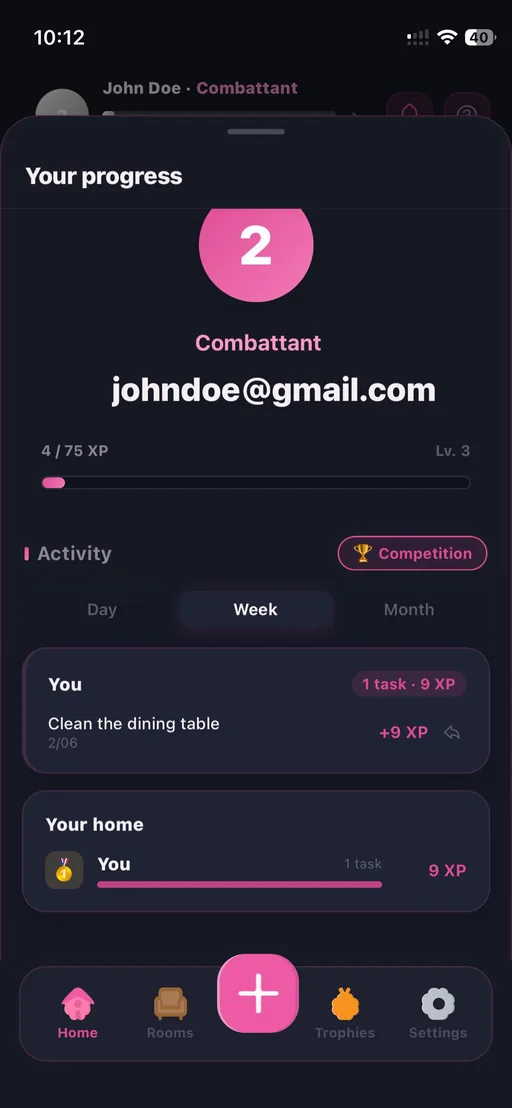
Complete and earn XP
Finishing creates immediate feedback and adds to visible progress.
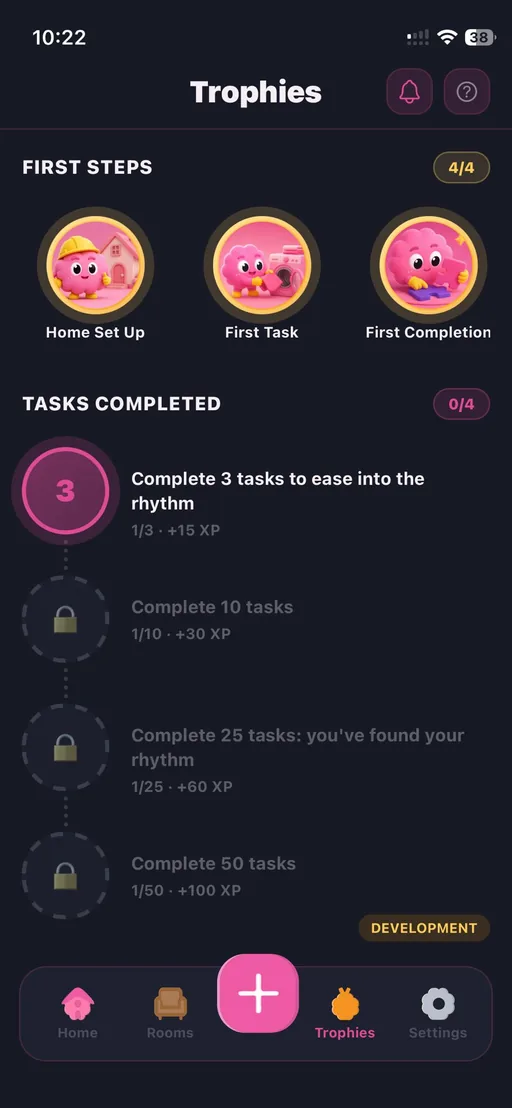
Level up over time
Trophies and levels make repeated household effort easier to recognize.
A reward system that only moves forward
Dopami rewards completion without taking progress away. XP and levels go up when missions are completed. A low-energy day does not erase previous work or create a punishment loop.
Small mission example: a quick tidy can earn +9 XP.
Larger mission example: vacuuming the living room can earn +20 XP.
Long-term feedback: levels, trophies and statistics show accumulated household progress.
A chore app for ADHD adults, not just kids
Many chore systems are designed around parents assigning tasks to children. ADHD adults also need support with home routines, especially when work, meals, laundry and admin all compete for the same limited attention.
For solo adults
- Use room-based suggestions instead of building a perfect list
- Choose one mission that fits current energy
- See proof of progress after repetitive chores
- Return after a difficult week without restarting from zero
For couples and roommates
- Make completed work visible
- Share responsibility across rooms
- Reduce repeated verbal reminders
- Use progress as encouragement, not blame
The goal is not to turn adulthood into a children's game. It is to give ordinary household work clearer feedback, a smaller starting point and a reason to come back.
How gamified chores can help families
In a family, chores are both a motivation problem and a visibility problem. One person often carries the planning while other contributions are hard to see. Dopami gives the household a shared view of missions and progress.
Less nagging
Assignments and completed missions are visible, so fewer reminders need to live in one person's head.
More flexible motivation
XP and trophies give the household a shared reward language without connecting every chore to money.
Clearer ownership
Family members can see what needs attention and who is handling it.
Progress without perfection
Completing one useful mission still counts, even when the whole house is not finished.
Dopami vs Chore Focus
Both apps organize household chores and can support shared homes. The main difference is the behavior each product is designed to encourage.
| Area | Dopami | Chore Focus |
|---|---|---|
| Best for | ADHD adults and households that struggle to choose, start and repeat chores | People who want a straightforward room-based chore tracker |
| Motivation | XP, levels, trophies and visible household progress | Achievements, reminders and progress tracking |
| Task initiation | Small missions and quick suggestions reduce decision fatigue | Users work from organized chore lists |
| Organization | Rooms, equipment and furniture help generate relevant missions | Chores organized by room |
| Household use | Shared progress for adults, couples, roommates and families | Assignments and tracking for individuals or households |
Choose Chore Focus if you mainly want a traditional room-by-room chore tracker.
Choose Dopami if the bigger problem is activation and you want a chore app built around small starts, gamified progress and ADHD-friendly follow-through.
What to look for in an ADHD chore app
- A clear next action instead of one overwhelming master list
- Quick setup that does not become another household project
- Visible progress and immediate feedback
- Flexible rewards without punishment for missed days
- Room-based context that reduces searching and deciding
- Shared visibility for families, couples or roommates
- A calm interface that keeps the chore more important than the game
Frequently asked questions
What is an ADHD chore app?
An ADHD chore app helps reduce the friction around choosing, starting and returning to household tasks. Useful features can include small next actions, visible progress, quick rewards and flexible shared routines.
Can gamification help adults with ADHD do chores?
Gamification can help some adults with ADHD by making progress visible, shortening the distance between effort and reward, and giving repetitive chores a clear finish line. It is a support tool, not a treatment, and it should avoid punishment or excessive complexity.
Is Dopami only for families with children?
No. Dopami is designed for ADHD adults, solo households, couples, roommates and families who want a more motivating household chore system.
What happens if I miss chores or stop using the app?
Dopami does not remove XP or levels when a day is missed. The next useful mission still counts, so returning does not mean rebuilding a streak from zero.
How is Dopami different from Chore Focus?
Chore Focus is a straightforward room-based chore tracker. Dopami puts more emphasis on ADHD-friendly task initiation, quick mission suggestions, XP, levels, trophies and shared household progress.
Start with one mission, not the whole house
The best chore app for ADHD adults or families is not the one with the longest feature list. It is the one that makes a useful task easier to start and gives you a reason to return.